

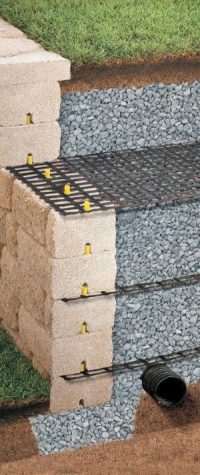
The following Installing procedures apply to all Nicolock retaining wall units constructed as a conventional gravity wall system.
Before beginning excavation, make sure there are no utility lines in the wall area. Excavate area to the proper depth. For geogrid-reinforced retaining walls or for more detailed information, consult your local distributor or contact Nicolock.
For most non-critical walls (and under favorable soil conditions) Nicolock wall units are constructed as a conventional gravity wall system. Walls up to 3 feet in height are attainable without the need for soil reinforcement (geogrid). Recommended installation procedures should be followed to ensure the life of your wall structure.
Excavate a trench a minimum of 6” beyond the front and back of the wall block. Dig trench 9” to 14” deep, enough to create a 6” thick leveling pad and to bury at least one whole wall block below grade. Compact the soil at the bottom of trench. Shape the slope behind wall to allow for 12” of drainage material.
Place filter fabric in trench and up the cut slope. Fill trench with clean, graded aggregate and compact.

Position a level string line at the straight face of the unit to maintain alignment. Place the wall units side by side in the center of the prepared base. Bury the first course of block below grade to a depth equal to 10% of the height of the wall or a minimum of 6”, whichever is greater. Level units from side to side, and front to back.
Fill the space in front of wall with clean fill to grade to hold units from shifting. Place a perforated pipe behind wall on top of base for drainage. Fill any block
cores and the drainage area with clean aggregate keeping filter fabric in place. Backfill soil on outer side of fabric and compact.
Place successive courses by fitting the keys and grooves onto the units in the row below (if applicable). Keep the tops of each course clean to maintain a level surface. Stack units one layer at a time in a running bond pattern (crossing joints). Utilize geogrid when the wall height is 3 ft or more or as required by the project engineer or approved design drawings.

Continue building the wall to the desired height. Backfill with clean aggregate behind each course as completed. Backfill and compact soil. Finish the wall by securing the wall cap with a suitable masonry adhesive.

Note: Illustrations shown are not for construction purpose. Please confer with your local engineer for proper placement of geogrid. Important: Walls higher than 36” above grade, terraced walls, weak soils, and other loading conditions require special considerations in design and construction. This should be done by a qualified engineer & a professional
contractor. Check with your local building department for code requirements.
Preparing for retaining wall installation starts with clearing the area, marking the layout, and digging a level trench. Add a compacted gravel base to create a stable foundation. Proper preparation ensures your wall remains strong and level over time.
The most common materials used in retaining wall installation include concrete blocks, natural stone, and brick. Concrete blocks offer strength and consistency, while natural stone delivers a more organic look. The right material depends on your design goals, site conditions, and budget.
Yes, good drainage is crucial during retaining wall installation. Adding gravel backfill and a perforated drain pipe helps prevent water buildup, which can cause pressure and structural issues. Proper drainage extends the life of your wall and keeps it looking great.
The time required for installing a retaining wall depends on the wall’s height, materials, and complexity. A small wall can be completed over a weekend, while larger, professional projects may take several days or more.
Before beginning retaining wall construction, always check local building codes and consider the soil type, drainage needs, and slope of your property. Planning ahead helps prevent costly mistakes and ensures a safe, long-lasting result.